
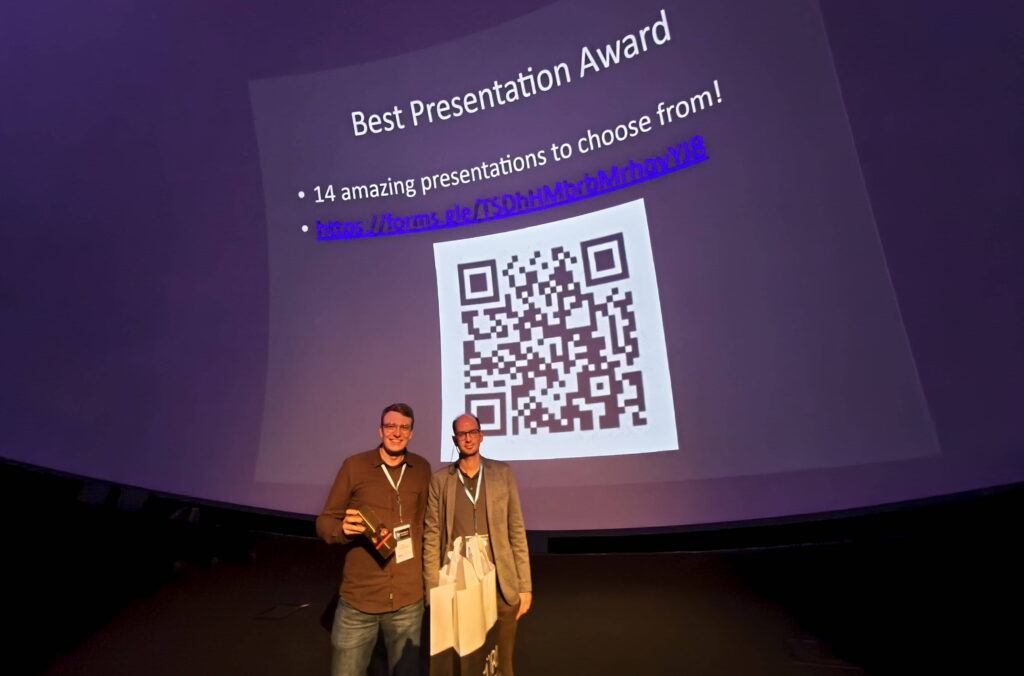
The SELF-MADE-ATC project has received international recognition at the 13th OpenSky Symposium held in Norrköping, Sweden in November 2025. During the conference, Niclas Wüstenbecker presented one of the team’s latest research papers, titled “Can YouTube Stream Recordings Improve Automatic Speech Recognition for Air Traffic Control?”
The team is proud to announce that the presentation was honored with the Best Presentation Award, as voted for by the conference audience. This award highlights not only the innovative quality of the research conducted within the SELF-MADE-ATC project, but also the team’s ability to communicate complex technical concepts effectively to the wider scientific community.
The paper authored by Niclas Wüstenbecker, Oliver Ohneiser and Matthias Kleinert addresses a critical bottleneck, the scarcity of labeled training data for automatic speech recognition (ASR) in air traffic control (ATC). To solve this, the team explored the potential of using open-source recordings from YouTube. Specifically, a massive dataset of virtual ATC speech from public flight simulation communities, such as VATSIM and IVAO, was collected, to see if this accessible data could improve model robustness in real-world environments.
The study provides a clear “yes” to the question of whether YouTube streaming of virtual ATC sessions can improve ASR in ATC. By developing an automated pipeline utilizing Large Language Model transcription fusion, the team processed over 2,000 hours of content from YouTube videos from 17 different countries.
Remarkably, the ASR model trained exclusively on YouTube stream recordings achieved a Word Error Rate (WER) of 21.1% on the very challenging operational ATCO2 benchmark. This significantly outperformed baseline models (35.6% WER) trained on smaller, but high-quality datasets, while also offering inference speeds approximately five times faster. These results prove that large-scale, diverse virtual data can effectively bridge the gap to real-world operational performance.
The full paper,can be found here (see preprint_8477_wustenbecker.pdf). Source Code will be published at a later stage.